By Connect Digital World | Tech News Made Easy
Imagine your school has a rule: “Nobody in the school office may use a certain app, because we are not sure where it sends our information.” That does not mean everybody in the whole country is banned from using that app. It just means the school office has decided to be extra careful.
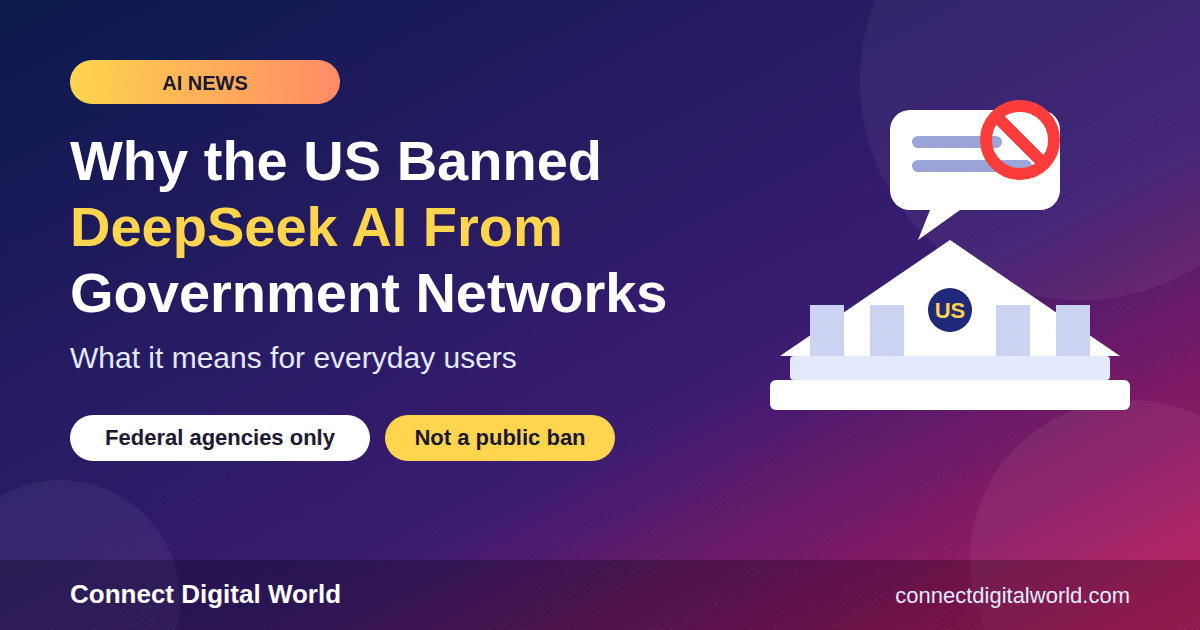
That is the best way to understand the big AI news from the United States this week. The US Department of Homeland Security (DHS) has ordered federal civilian agencies to remove the Chinese AI company DeepSeek from their computer systems. In this guide, we explain the story in simple words: what the order says, why it happened, what it does not do and what everyday users should know.
Quick Summary: The News in 30 Seconds
- DHS ordered US federal civilian agencies to stop buying DeepSeek products and to remove them from their IT systems.
- The order also covers third-party tools built on DeepSeek’s AI models.
- DHS says DeepSeek’s models create “multiple threat vectors”, including the risk that sensitive government information could be sent to China.
- It is not a nationwide ban. It does not stop ordinary people or private companies from using DeepSeek.
- Military and intelligence systems are not covered by this particular order.
What Is DeepSeek?
DeepSeek is an AI company based in Hangzhou, China. It became famous in early 2025, when its chatbot and AI models surprised the world by performing well while reportedly costing much less to build than many rivals. Its app quickly shot to the top of app store charts in several countries.
Like ChatGPT and Gemini, DeepSeek lets you ask questions and get answers in plain language. It also released some of its AI models as open-weight models, which means developers can download them and run them on their own computers. We will explain that term in a moment.
What Exactly Did the US Government Order?
The order was issued by the Department of Homeland Security. Here are the main points, in simple language.
1. A Ban on Buying
Federal civilian agencies cannot acquire DeepSeek products and services any more. That covers every buying route, such as approved product lists and online marketplaces.
2. A Requirement to Remove
Agencies must take DeepSeek products out of their IT systems. This also applies to third-party products or services developed using DeepSeek technology. If an agency thinks it truly needs a DeepSeek product, it can ask DHS for an exception, a waiver or more time.
3. Extra Care Until Removal Is Done
While agencies are still removing the products, they are told to watch network traffic more closely, increase logging, add controls to stop data leaving their systems and flag anything unusual.
4. Who Is Covered?
The order covers federal civilian executive-branch agencies, such as departments like Treasury, State and Justice. It does not extend to national security systems or highly classified systems, which are managed by the Pentagon and the Director of National Intelligence.
When Did This Happen?
DHS filed its notice around October 19 and it was due to appear in the Federal Register on October 20, 2026, under docket number DHS-2026-0628. One report says the order itself was signed earlier, in July, and only made public in October.
Which Law Was Used?
DHS used a law called the Federal Acquisition Supply Chain Security Act of 2018, often shortened to FASCSA. It is a mouthful, but the idea is simple. The law lets the government protect itself from risky products and services in its “supply chain”.
What Is a Supply Chain?
Think about building a bicycle. You need wheels, a chain, brakes and a seat, and each part comes from somewhere. If one part is faulty or has a hidden problem, the whole bike could be unsafe. In technology, a “supply chain” is all the software, hardware and services that make up a product. If one piece, like an AI model, is risky, it could create trouble for everything built on top of it.
DHS said it acted after reviewing a recommendation from the Federal Acquisition Security Council, a group that looks at supply-chain risks to the government.
Why Did DHS Ban DeepSeek? The Security Reasons
According to reports on the DHS notice, the department raised several concerns:
- Data going to China. DeepSeek’s services use servers in China, and DHS warned that sensitive government information could be transferred there. The order says this might expose intelligence about US citizens and government programs.
- Tracking users. Concerns were raised about the way user information could be collected and tracked.
- Weak app security. DHS pointed to open-source security research that found multiple critical vulnerabilities in DeepSeek’s iOS app. A vulnerability is a weak spot that attackers could use.
- “Multiple threat vectors.” This is DHS’s way of saying there are several different ways something could go wrong.
It is worth noticing that these are the government’s stated concerns. DeepSeek had not publicly responded in the reports we reviewed, so we do not yet know its side of the story.
Is This a Nationwide Ban? No.
This is the most important thing to understand, and many headlines make it confusing. The order is about federal civilian government computers and purchases. It does not:
- Stop ordinary people from using DeepSeek.
- Ban DeepSeek for private companies in general.
- Remove DeepSeek from app stores.
However, companies that sell software to federal agencies may be affected. If their products use DeepSeek models inside them, they may need to change them. Experts say this makes it important for software companies to know exactly which AI models their products rely on, an idea often called software provenance, which simply means knowing where your software’s parts come from.
Is This the First Restriction on DeepSeek?
No. Pressure on DeepSeek has been building for more than a year:
- In early 2025, agencies such as the US Navy and NASA began blocking the DeepSeek chatbot on their own.
- In March 2025, the US Department of Commerce banned DeepSeek on government-furnished equipment, according to Reuters.
- Texas became the first US state to restrict it in January 2025, and other states followed with their own rules.
- Governments in several other countries also restricted or investigated DeepSeek in 2025.
The new DHS order is bigger because it covers every federal civilian agency and everything those agencies buy, including tools that build on DeepSeek.
What Does “Open-Weight” Mean? (And Why It Matters Here)
You may hear the phrase open-weight AI. Here is a simple way to picture it.
An AI model is like a giant recipe book that the computer has learned. The “weights” are the numbers that hold what it has learned, like the finished flavours of the recipes. If a company releases the weights, anyone can download them and run the AI on their own computer, instead of using the company’s website or app.
- Cloud AI: You type into someone else’s website, and your words travel to their servers.
- Open-weight AI run locally: The model runs on your own machine, so your words may not need to leave it.
This matters because the biggest worry in the DHS notice is about data travelling to servers in China. Running an open model locally is a different situation from using the DeepSeek app. But the DHS order also targets third-party tools built on DeepSeek models, and it does not clearly define what “developed using DeepSeek implementations” means. So the exact rules for locally run models inside government-linked products are still being worked out.
The debate also sits inside a bigger political argument. Some US politicians worry that free, powerful AI models from China could undercut American AI companies. That is one reason open-weight models have become a hot topic in Washington.
What Does This Mean for Everyday Users?
If you are not a government employee or a government supplier, nothing forces you to stop using DeepSeek. But the news is a good reminder to think about privacy. Here are some simple questions to ask about any AI app, not just DeepSeek:
- Where does my information go? Check the privacy policy for where data is stored and who can see it.
- What does the app collect? Look for requests for your contacts, location or files that the app does not really need.
- Who owns the company? Different countries have different laws about what companies must share with governments.
- Is the app kept up to date? Security problems get fixed through updates.
- Can I delete my data? Good services let you remove your chat history.
Smart Habits for Using Any AI Chatbot
- Do not type passwords, bank details, ID numbers or private medical information into a chatbot.
- Do not paste secret work documents or your company’s private code into a public AI tool unless your employer has approved it.
- Use official apps from the official app stores, and watch out for fake copycats.
- Check privacy settings and turn off chat history or training if you can.
- Keep your phone and apps updated.
- For anything important, double-check the AI’s answers. All chatbots can make mistakes.
What Does It Mean If You Work for a Company That Sells to the Government?
If your company supplies software or services to US federal civilian agencies, here is a short checklist:
- List every AI model and AI service inside your products.
- Find out whether any of them are made by DeepSeek or built using DeepSeek technology.
- Talk to your legal and security teams about the order’s requirements.
- Ask your suppliers about the models they use.
- Keep records, because customers will increasingly ask where AI components come from.
This is general information, not legal advice. Companies should read the official notice and talk to qualified professionals.
Is DeepSeek Dangerous?
This question needs a careful answer. The DHS order shows that the US government sees serious security risks in using DeepSeek on its own networks, where information is highly sensitive. That does not automatically mean the average person’s chats are in danger, and it does not prove any particular wrongdoing by DeepSeek. Security experts often say the same thing about many apps: the more sensitive your information, the more careful you should be about where it goes.
The simple rule is this: match the tool to the task. For a joke or a recipe, risk is low. For private business plans, official documents or personal data, choose tools you trust and understand.
What Might Happen Next?
- DeepSeek may respond publicly or challenge the order.
- State governments, schools and other organisations may copy the federal rules.
- Vendors that sell to the government will review their AI components.
- The US government could extend restrictions further, or other countries could take similar steps.
- The wider debate over open-weight AI models, Chinese AI and American AI will continue.
These are possibilities, not certainties. We will keep following the story.
Simple Word List (Glossary)
- DHS: The US Department of Homeland Security.
- DeepSeek: A Chinese AI company known for its chatbot and AI models.
- Federal civilian agencies: Parts of the US government that are not military or intelligence.
- FASCSA: The 2018 law that lets the government remove risky products from its supply chain.
- Supply chain: All the parts, software and services that make up a product.
- Vulnerability: A weak spot attackers could use.
- Open-weight model: An AI model whose learned numbers can be downloaded and run on your own computer.
- Cloud AI: AI that runs on a company’s servers over the internet.
- Federal Register: The official daily publication of US government notices.
- Provenance: Knowing where something, such as software, comes from.
Frequently Asked Questions (FAQ)
Has the US banned DeepSeek completely?
No. The order applies to federal civilian agencies and their purchases. It does not ban DeepSeek for the general public.
Why did DHS order DeepSeek removed?
DHS says DeepSeek’s models pose several security risks, including the possibility that sensitive government information could be transferred to China, and it cited vulnerabilities in the DeepSeek iOS app.
Does the order cover the military?
No. National security and classified systems are not covered by this order. Those fall under the Pentagon and the Director of National Intelligence.
Does it cover tools built on DeepSeek?
Yes. The order also covers third-party products and services developed using DeepSeek technology, though the exact meaning of that phrase has not been fully defined.
Can I still use DeepSeek on my phone?
The order does not stop individuals from using it. But if you work for a federal civilian agency or a government supplier, follow your organisation’s rules.
Is DeepSeek safe to use?
It depends on what you share. Avoid entering sensitive personal or business information into any AI app, especially if you do not know where the data is stored.
What is the Federal Acquisition Supply Chain Security Act?
It is a 2018 US law that allows agencies to exclude or remove risky technology products and services from government networks and purchases.
Has DeepSeek responded?
The reports we reviewed said DeepSeek had not immediately responded. Check for fresh news.
Final Thoughts
The US government’s order on DeepSeek is a big signal about how seriously governments now treat AI security. But the facts are narrower than some headlines suggest: this is a rule for federal civilian government systems, not a ban for everyone.
For regular users, the lesson is useful and simple. Before you hand your information to any AI tool, ask where it goes, who can see it and whether you really need to share it. A little caution goes a long way.
What do you think about governments restricting AI tools? Tell us in the comments. For more easy tech news, keep following Connect Digital World.
Sources and further reading: Reporting on the DHS notice (docket DHS-2026-0628) from PYMNTS, BankInfoSecurity, TechRepublic, ExecutiveGov, Technology.org and other outlets, plus earlier coverage of DeepSeek restrictions. Details may be updated, so check the Federal Register and official statements.